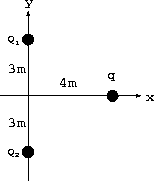
1. (25 points) Two point charges Q1 = Q2 = +25nC are located on (0, 3m) and (0,-3m) on the y-axis. A testing charge q = +1nC is put at position (4m, 0) on the x-axis.
(a) (5 points) Draw a free-body diagram for the testing charge.
(b) (5 points) Find the electric force (magnitude and direction) acting on the testing charge.
(c) (5 points) Find the potential energy of the above testing charge.
(d) (5 points) If the testing charge is released from rest at its initial position, it will escape. Why? How about a negative testing charge?
(e) (5 points) Find the escaping speed when this testing charge moves to infinity. Assume the mass of the testing charge is 10-10g.
2. (25 points) The Gauss’s law. Charge Q is uniformly distributed in a sphere with radius R.
(a) (5 points) Find the net electric flux through the surface of a concentric sphere with radius r when i) r < R and ii) r > R.
(b) (5 points) Find the electric field at a distance r away from the center when i) r < R and ii) r > R.
(c) (5 points) Draw a figure showing the radial component of the electric field as a function of the distance r.
(d) (10 points) Find the electric potential at a distance r away from the center when i) r < R and ii) r > R. Take the potential at infinity as zero. Hint: Using the relation
 | (1) |
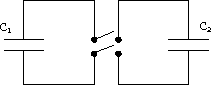
3. (25 points) A capacitor is a device which is able to store electric energy. In a network of
capacitors shown in the figure below, the capacitor C1 = 4 C has an initial voltage
100V . The switch is then closed such that the capacitor C2 = 2F is charged by C1.
C has an initial voltage
100V . The switch is then closed such that the capacitor C2 = 2F is charged by C1.
(a) (5 points) Find the charge Q in C1 and the electric energy U stored in this network of capacitors before the switch is closed.
(b) (5 points) After the switch is closed, what is the equivalent capacitance of this network of capacitors? Are capacitors connected in serial or parallel?
(c) (5 points) Find the charge Q1 in C1 and Q2 in C2 after the switch is closed.
(d) (10 points) Find the electric energy U' stored in this network of capacitors after the switch is closed. Explain the energy loss if any.
4. (25 points) A metal sphere with charge +q and radius ra is placed at the center of a metal spherical shell with charge -q, inner radius rb and outer radius rc. Here ra < rb < rc.
(a) (10 points) Find the potential V (r) for r < ra, ra < r < rb, rb < r < rc and r > rc.
(b) (5 points) Find the capacitance C formed by the sphere and the shell.
(c) (5 points) Find the surfaces charge density at the surface of the sphere, the inner and outer surfaces of the shell.
(d) (5 points) Draw the electric field lines in all regions.
(e) (extra credit, 10 points) If the space between the sphere and the shell is filled by a dielectrics with a dielectric constant K = 3, find the electric field in the regions ra < r < rb and the induced surface charges at r = ra and r = rb.
(f) (extra credits, 5 points) Following (e), redraw the electric field lines in all regions. Label the free surface charges and induced surface charges in your graph.