|
You have 2 hour 20 minutes to answer 7 questions on this exam. Work each problem only on the sheet provided for this problem, using the back if necessary. Please write the name and recitation section on each sheet at the top of the page.
You must indicate the reasoning and show all the steps.
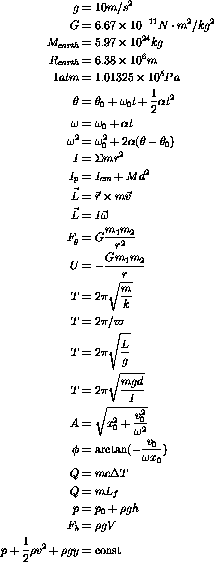
If you are unable to obtain the answer to part of a problem and you need the answer to solve the subsequent parts, use an appropriate symbol for the answer to the previous part and solve in terms of that symbol. The following may be useful:
|
|
1. You may solve one of the two subquestions here and circle the subquestion for which to be
graded. Subquestion (a) will be graded if no explicit selection is made.
(a) A ball is thrown vertically upward from the edge of a tower that is 50.0m above the
ground. The ball is thrown with an initial speed of 30.0m/s. It returns just missing the
tower, and finally hits the ground. Ignore the air resistance.
i. Find the time required for the ball to reach its maximum height.
ii. What is the highest distance of the ball above the ground?
(10 points)
(b) A student wants to throw a stone into a window h = 7m high and x = 16m away from
him. He throws the stone along 36.9o above the horizontal and the stone just hits the
window. Find the initial velocity of the stone and the time the stone takes to hit the
window.
(10/15 points)
2. Two blocks A, B of mass m = 1kg are connected by a cord through a frictionless pulley.
Block A rests on an incline which is inclined at an angle 36.9o above the horizontal
and block B hangs in the air h = 1m above the ground. Assume the coefficient of
kinetic friction between the block and the incline is 0.2. The blocks are released from
rest.
(a) Draw the free body diagram for the two blocks.
(b) Use the second law of Newton to find the velocity of block B when it hits the
ground.
(c) Resolve (b) by work-energy theorem.
(25 points)

3. You may solve one of the two subquestions here and circle the subquestion for which to be
graded. Subquestion (a) will be graded if no explicit selection is made.
(a) A m = 2000kg limousine is traveling at a speed of vm = 20.0m/s to the north on a
through street when it is struck by a M = 3000kg panel truck traveling to the east at
vM = 10.0m/s. The vehicles lock together and leave the point of impact at an angle of
53.1o north of east with velocity v'. The coefficient of kinetic friction between cars and
ground is 0.5.
i. It is a good approximation that linear momentum is conserved during the
impact. Please explain.
ii. Determine the velocity v' with which the cars leave the point of impact.
iii. Find the slippage of the cars after the impact.
(25 points)
(b) A diver comes off a diving board with arms straight up and legs straight down, giving
him a moment of inertia about his axis of rotation equal to 20kgm2. He then tucks into a
small ball, decreasing his moment of inertia to 3.6kgm2. While tucked he makes two
complete revolutions in 1.2s. If he hadn’t tucked at all, how many revolutions
would he have made in the 1.5s from board to water? You can make reasonable
approximations.
(25 points)
(25 points)
4. A block of mass 10kg connected to a massless spring undergoes simple harmonic motion
(SHM) on a horizontal frictionless surface. At t = 0 the block is released from rest at
x0 = -0.5m, and it reaches its maximum speed vmax for the first time at x = 0 and
t =  s.
s.
(a) Find the period T , the amplitude A, angular velocity  and phase angle of this
SHM and then write down x(t), the position of the block at any time.
and phase angle of this
SHM and then write down x(t), the position of the block at any time.
(b) Find the force constant of the spring.
(c) Find vmax.
(d) (Optional) Find the shortest time that it takes for the block to travel to x = 0.8A.
(20/30 points)
5. You may solve one of the two subquestions here and circle the subquestion for which to be
graded. Subquestion (a) will be graded if no explicit selection is made.
(a) Tom wants to float himself in water using a plastic board. His weight is 75kg.
Find the minimum size of the board he needs. The thickness of the plastic board is
2cm and its density 0.2g/cm3. The density of a person is 1.2 × 10³kg/m3. You can
assume Tom is totally submerged in water.
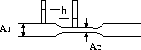
(b) Venturi meter can be used to measure flow speed in a pipe. If the cross section
areas A1 = 4cm2 and A
2 = 2cm2 at the throat, the difference in height of the liquid
levels in the two vertical tubes is h = 3cm. Find the flow speed at cross area A1.
(20/25 points)
6. To cool a cup of water at 27oC, a block of ice is put into the cup. Assume the cup is made of
glass and its mass is mglass = 50g, the amount of the water is mwater = 200g, and the volume
of the ice block is V ice = 10cm3. You may use the specific heat capacity of glass
cglass = 838J/kgK, the specific heat capacity of water cwater = 4190J/kgK, the fusion heat of
water Lf = 334 × 103J/kg, and the density of ice 0.92 × 10³kg/m3.
(a) Find the mass of the ice.
(b) Find the final temperature of the water. Ignore the heat exchange with the
environment.
(20 points)
7. You need not show any calculation for the following subquestions.
(a) Explain the origin of g = 9.8m/s2.
(b) Provide one example in your everyday life which may be explained by what you
have learned in the course and explain it.
(c) How do you think about this course? Write a short paragraph within 150 words.
(25 points)