|
You have 1 hour to answer 4 questions on this exam. Work each problem only on the sheet provided for this problem, using the back if necessary. Please write the name and recitation section on each sheet at the top of the page.
You must indicate the reasoning and show all the steps.
If you are unable to obtain the answer to part of a problem and you need the answer to solve the subsequent parts, use an appropriate symbol for the answer to the previous part and solve in terms of that symbol. The following may be useful:
|
|
1. A 10kg block placed on a horizontal plane is dragged by an external force F = 100N along 37o
above the horizontal direction for 10m from rest. The coefficient of kinetic friction between the
block and the plane is 0.2.
(a) Find the work done by the external force and the friction respectively. Explain the
signs.
(b) Find the final velocity of the block using the work-energy theorem.
(c) Repeat (b) using the 2nd law of Newton.
(25 points)
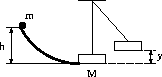
2. In the experiment about linear momentum, a ball m moves down from rest along a track whose height is h and hits a hanged wooden block M. The ball is then embedded in the wooden block after the impact and the block swings up for some height y.
(25 points) We will now assume the track is frictionless. See the figure below.
(a) Identify the conserved quantities before, at and after the impact.
(b) Express y using h, m, M.
(c) Find the amount of the mechanics energy lost using h, m, M. Explain where goes
the lost mechanics energy.
(25 points)
3. A horizontal turnable table with radius 2m starts rotation along the central vertical axis from
rest. It has an angular acceleration  -1rad/s2 in the first revolution and then the acceleration
is off (it moves at a constant angular velocity afterwards). The moment of inertia of the table
along the axis is 50kg
-1rad/s2 in the first revolution and then the acceleration
is off (it moves at a constant angular velocity afterwards). The moment of inertia of the table
along the axis is 50kg  m2.
m2.
(a) What is the angular velocity of the table after its first revolution?
(b) When it is in the 3rd revolution, a bag with mass 10kg is dropped onto the rim of
the table and then the bag moves with the table on the rim. Find that new angular
velocity of the table after the impact.
(c) Find the amount of lost kinetic energy.
(d) Assume the kinetic energy is lost solely due to the kinetic friction between the bag
and the table and the coefficient of the kinetic friction between them is 0.5, estimate
the distance the bag slips on the table.
(25 points)
4. A block A with mass mA = 8.00kg is placed on a horizontal frictionless table and is connected
to a second hanging block B with mass mB = 6.00kg by a cord with length l = 10m through a
hole at the center of the table. Initially, the block A moves uniformly in a circle of radius
r = 1.2m around the hole.
(a) Find the angular velocity  of the block A.
(b) Find the angular momentum L of the block A.
(c) The mass of block B increases slowly until the radius r is 0.6m. Prove the angular
momentum of the block A is conserved during this process and find the new angular
velocity of the block A.
(d) Take the level of the table as zero potential gravitational energy, does the total
mechanics energy of the system change during this process? Explain. (A satisfactory
explanation may gain 10 extra points.)
(25 points)