|
You have 2 hour 20 minutes to answer 7 questions on this exam. Work each problem only on the sheet provided for this problem, using the back if necessary. Please write the name and recitation section on each sheet at the top of the page.
You must indicate the reasoning and show all the steps.
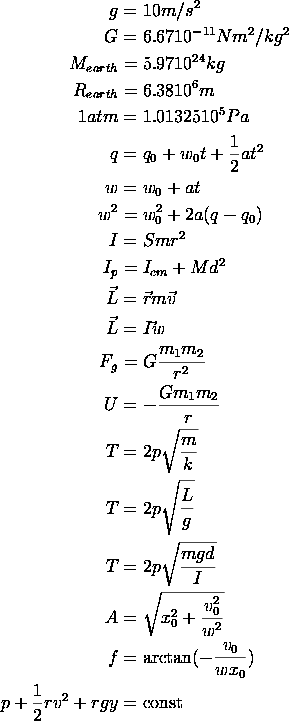
If you are unable to obtain the answer to part of a problem and you need the answer to solve the subsequent parts, use an appropriate symbol for the answer to the previous part and solve in terms of that symbol. The following may be useful:
|
|
1. A projectile is fired with a velocity 300m/s at an angle 37o above the horizontal from the
ground.
(a) Find the (x, y) coordinates of the highest point reached. Take your origin at the
firing point.
(b) If at the highest point, the projectile explodes into two equal mass parts A and B
with V Ax =  V Bx, V By = 0. Find V Ax and V Ay.
(c) Where will part A hits the ground?
(25 points)
2. The uniform beam AB weighs 700N. It is supported in equilibrium by a cable at B and a pin
at A, as indicated.
(a) Draw the free body diagram of the beam.
(b) Find the tension T in the cable.
(c) Find the components Ax, Ay of the force exerted by the pin on the beam.
(d) Find the angle between force  and the vertical line. Indicating in the figure.
(30 points)
3. A mass m is tied to the free end of a massless cable which is wrapped around a solid cylinder
with mass M and radius R. The cylinder can freely rotate about its axis without any
friction. The mass m is released with no initial velocity at a distance h above the
floor. The momentum of inertia of a solid cylinder about the symmetrical axis is
I =  MR2.
MR2.
(a) Using energy method, find the angular velocity of the cylinder just as the mass
strikes the floor.
(b) Find the angular acceleration of the cylinder.
(20 points)
4. A spacecraft revolves around the earth in an elliptical orbit. At the low point, or perigee, of its
orbit, it is 500km above the earth’s surface; at the the high point, or apogee, it is 5000km
above the earth’s surface.
(a) The angular momentum of the spacecraft is conserved. Why?
(b) Using conservation of angular momentum, find the ratio of the speed of the
spacecraft at perigee to that at apogee.
(c) The energy of the spacecraft is conserved. Why?
(d) Using conservation of energy and the result of part (b), find the speed of the
spacecraft at perigee and the speed at apogee.
(e) Find the angular momentum and energy of the spacecraft.
(35 points)
5. A block of mass 10kg connected to a massless spring undergoes simple harmonic motion
(SHM) on a horizontal frictionless surface. The spring constant is 160N/m. At t = 0 the block
is at x0 = -0.5m with speed v0 = 0. After being released, the block reaches its maximum
speed vmax at x = 0.
(a) Find the period T of this SHM.
(b) Find the amplitude A of this SHM.
(c) Using conservation of energy to find vmax.
(d) Write down the general form x(t), the position at any time.
(e) Write down the general form v(t), the velocity at any time.
(f) Find the shortest time that it takes for the block to travel from x = 0.8A to
x = -0.6A.
(30 points)
6. An object of mass 5kg and specific gravity 2.7 is suspended from a spring and immersed in
water. (The specific gravity of a material is the ratio of its density to the density of water; the
density of water is 1000kg/m3.)
(a) What is the reading of the spring balance (in N)?
(b) If the object is suspended in alcohol, the balance reads 35N, what is the specific
gravity of the alcohol?
(20 points)
7. The following two subquestions are unrelated.
(a) A laboratory technician drops a 0.010kg sample of unknown material, at a
temperature of 100.0oC, into a calorimeter. The calorimeter can, initially at 27oC,
is made of 0.2kg copper of contains 0.3kg water. The final temperature of the
calorimeter is 28oC. Compute the specific heat capacity of the sample. ( Take
ccopper = 390J/kgK, cwater = 4190J/kgK.)
(b) A U-shaped tube with both ends open to air contains some mercury. Then one end of the
tube is sealed and some air with volume V 1 = 10cm3 is confined inside. After that, a
quantity of mercury is carefully poured into the open end of the tube until the distance h
between the tops of mercury in left and right arms becomes 36cm. Assume the
compression of the air inside the tube is isothermal and the temperature is T = 27oC.
Take R = 8.31J/molK, rmercury = 13.6103kg/m3.
i. Find the number of moles n of the air confined inside the tube.
ii. Find the pressure P 2, the volume V 2 of the confined air after the isothermal
compression.
iii. Find the work W , the heat Q and the change DU in internal energy of the
confined air for this process.
(30 points)
(40 points)