1. (20 points) A car of mass 1.76 × 10³kg moving on a flat road undergoes uniform circular motion when rounding a curve. The constant speed of the car is 12.9m/s and the curve has a radius of 73.1 m . The coefficient of kinetic friction between the car’s tires and the road is 0.690 and the coefficient of static friction is 0.920.
(a) (5 points) Draw a free-body diagram for the car, clearly labeling all forces using commonly accepted symbols (T for tension, N for normal force, etc.).
(b) (5 points) What is the magnitude of the static friction force between the car’s tires and the road?
(c) (5 points) What is the maximum speed that the car may have before its tires slip on the road?
(d) (5 points) At what angle must the road be banked in order that the car will not slide while rounding the curve under icy conditions (assume no friction) using v = 12.9m/s ?
2. (25 points) A box of mass m = 1kg is suspended by a string of length L = 2m in the vertical direction. This box is moved side way for a distance of 1.2m slowly under the action of a horizontal force F.
(a) (5 points) Draw a free body diagram for the box.
(b) (5 points) Find the magnitude of the horizontal force F when the string forms an angle
 from the vertical direction.
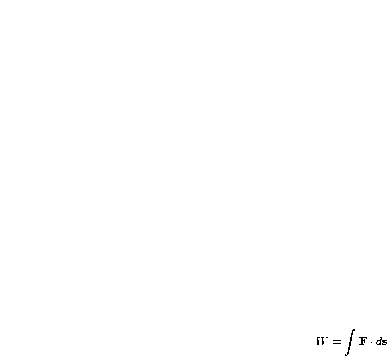
(c) (10 points) Calculate the work done by the force F directly using the formula:
 | (1) |
.
(d) (5 points) Recalculate the work done by the force F using the work-energy theorem:
 | (2) |
3. (20 points) A skier starting at rest coasts down a slope that makes an angle of 30 degrees with the horizontal. The skier makes a total vertical descent of 100m and then coasts along a level section which runs for 400m before ending in a cliff.
(a) (10 points) How large must the coefficient of friction be to just prevent the skier from going over the cliff?
(b) (10 points) Using the coefficient of friction found above, what is the maximum velocity that can be attained by the skier?
4. (15 points) A ball is thrown upward and towards a vertical wall. The ball has a mass of 0.15kg and is travelling at 14m/s when it strikes the wall at an angle of 45 degrees. It bounces off the ball at the same angle and speed after t = 20ms. NOTE: omit the force of gravity!
(a) (10 points) Find the change of the momentum of the ball. What is the impulse on the ball?
(b) (5 points) Determine the average force that the ball exerted on the wall.
5. (20 points) A 10.0g bullet with a horizontal speed of 200m/s is fired at and stuck inside a 990g wood block attached to a spring placed at rest on a frictionless horizontal surface. The spring is compressed for a maximum value of 1cm. Find the force constant of the spring.