You have 2 hour 15 minutes to answer 9 questions on this exam. Work each problem only on the sheet provided for this problem, using the back if necessary. Please write the name and recitation section on each sheet at the top of the page.
You must indicate the reasoning and show all the steps.
If you are unable to obtain the answer to part of a problem and you need the answer to solve the subsequent parts, use an appropriate symbol for the answer to the previous part and solve in terms of that symbol.
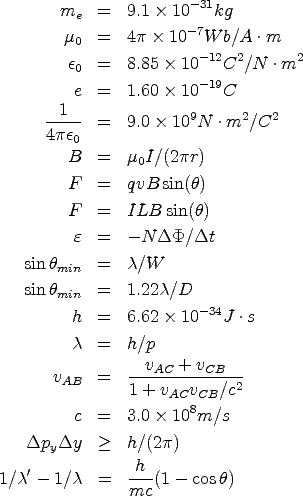
Some useful constants and formulas are given here:
1. (5 points) Explain the fact that you see yourself upright when you look at the back side of a shiny teaspoon held at arm’s length. Draw a ray diagram to support your reasoning.
2. (10 points) The eye of human being can not resolve the headlights of a car far away. Why? Estimate the distance at which one can hope to distinguish the headlights of a car. The pupil of your eye has a diameter of 2mm. The visible light has a wavelength of about 500nm.
3. (5 points) One system consists of two stationary electrons, separated by a distance of r. Another consists of a positron and an electron, both stationary and separated by a distance of r. A positron has the same mass as an electron, but it has a positive electric charge +e. Which system, if either, has the greater mass? Give your reasoning.
4. (5 points) The wave-particle duality is now accepted as an essential part of nature. Please give two experiments where light demonstrates its wave and particle characteristics respectively. Describe them briefly.
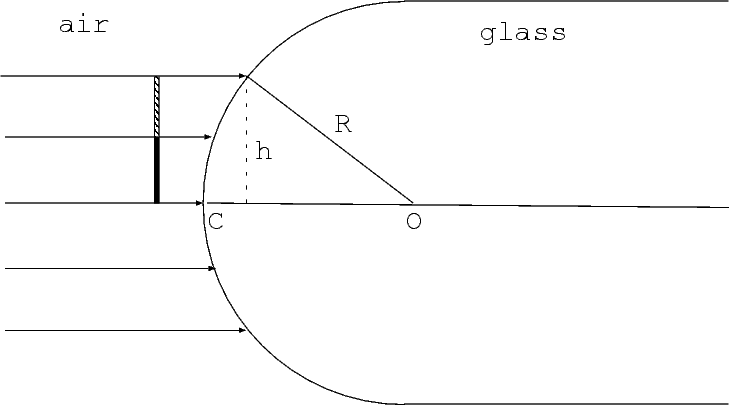
5. (20 points) A piece of glass, of index of refraction n = 1.5, has one surface polished into a sphere of radius 5cm, as shown. The normal to a sphere is always along a radius. Rays of light strike the glass from the left, as shown.
6. (10 points) A green light ( vacuum = 552nm) strikes the glass plates nearly perpendicularly.
The two glass plates form an air wedge. The number of the bright fringes occurs between the
place where the plates touch and the edge of the sheet of aluminum is found to be 100.
vacuum = 552nm) strikes the glass plates nearly perpendicularly.
The two glass plates form an air wedge. The number of the bright fringes occurs between the
place where the plates touch and the edge of the sheet of aluminum is found to be 100.

7. (15 points) Electrons are moving with a velocity 5 × 10⁶m/s. These electrons are used to
perform the Young’s double slit experiment where the separation between the two slits
is d = 1 m and the detector is placed at a distance of L = 5m behind the slits.
8. (15 points) A person runs 100m in 10s in a train along a straight line in the same direction as the train moves. The train moves at a velocity 0.8c relative to the ground. c is the speed of light.
9. (15 points) In the Bohr’s Hydrogen atom model, the energy levels are given by: En = (-13.6ev)/n2 where n = 1, 2, 3,....
 ke2/a.